Why the most dangerous line in your vendor contract is the one nobody reads before they sign
Seems like the question every executive is getting right now is “are you using AI?” Nobody is asking the one that actually matters.
Where does your data go when you put it in?
Not how does the interface look. Not what are the pricing tiers. Not does the demo have a nice competitor intelligence module that makes your VP of Operations lean forward for the first time in two years.
Where. Does. Your data. Go.
I have been in rooms where the most valuable competitive data a company owned was being routed into a shared AI model in real time while the leadership team was in the same building talking about how excited they were about the rollout. Eighteen months of AI adoption. Eighteen months of training their competitors.
The machine doesn’t know the difference between your data and your competitor’s data. The machine is not loyal to your organization. The machine is obedient. It will do exactly what the terms of service say it will do. And the terms of service were written by lawyers whose client was not you.
The product is not the software. You are the product. Specifically, your data is.
Most AI platforms running today operate on the same basic business model: aggregate client data, train a shared model on it, license that shared model back to your entire market, including the companies competing against you for the same customers. The vendor will describe this as “collective intelligence” and “continuous model improvement.” What it actually is, is this: you hand them your institutional memory and they sell everyone in your industry the insights it generates.
Your routing history is not administrative overhead. It is your operations compressed into data, built over years, irreplaceable, and it cannot be bought or replicated in a quarter. Your vendor performance records are a competitive intelligence asset. Your quality control logs are a pattern library. An AI agent trained on that data in isolation can find in seventy-two hours what your team has been walking past for years.
Feed it into a shared platform and you have just given your competitors a shortcut through everything you built.
They will tell you the data is anonymized.
They will tell you this with the confidence of people who have said it many times and have not been proven wrong in a way they could not explain away.
Ask the direct question anyway. Does our proprietary data stay isolated from the shared model?
Then watch the pause before the answer.
The pause is the answer.
The organizations that are going to own their markets in the next five years are not the ones that bought the best AI platform. They are the ones that figured out that the data they already have, properly organized, properly isolated, properly trained on, is worth more than anything they could purchase. They are building walls around that data and training AI on it in isolation and producing outputs their competitors genuinely cannot replicate. Not because the technology is proprietary. Because the data is.
You do not need to build it yourself.
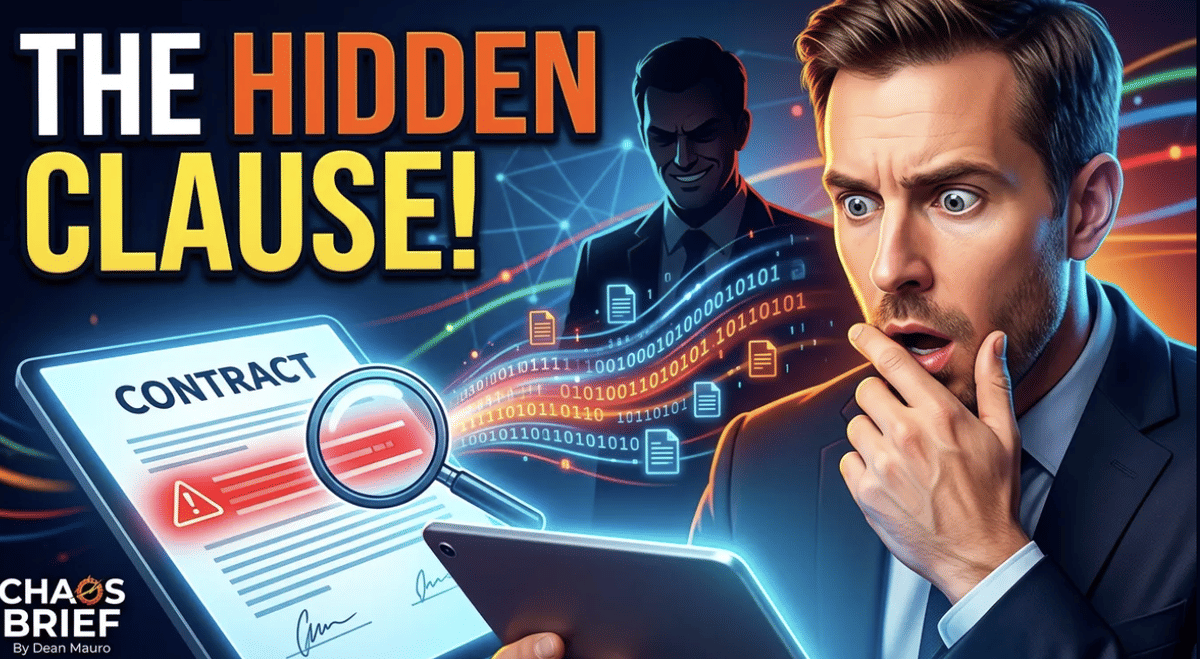
You need to read section 4.2 before you sign.
Read it before the demo. Read it before the pilot. Read it before the impressive dashboard and the four-person sales team and the competitor intelligence module that makes everyone in the room lean forward.
Ask the direct question. Watch the pause.
Now. Here is the part nobody is talking about.
While you are evaluating the vendor, while you are in the demo, while you are deciding whether the pricing fits the budget and the implementation timeline is manageable, something else is already happening inside your organization.
Six people in vendor management found a contract summarizer in Slack. They have been running client contracts through it for a week. Two people in HR are generating job descriptions with a free tool they downloaded. Someone in IT connected three internal reporting systems to an AI dashboard aggregator they found on GitHub at eleven o’clock on a Wednesday night and deployed without a security review because deployment took twenty minutes and the security review would have taken three weeks.
Nobody asked. Nobody filed a request. Nobody read the terms of service.
The door you opened at the all-hands, the one where you told the organization we are moving forward on AI, that door does not stay the size you made it.
And here is the thing that should make you stop moving for one moment and pay attention.
Your AI tool, the one you approved, the one you evaluated, the one Tom in IT built from scratch on clean isolated data and ran for seventy-two hours against every data source in the building?
It just found something.
Eleven months of anomalies in the quality control logs. A pattern statistically impossible as random error. Access events clustering around a single credential. A credential provisioned one month before the pattern started.
Precise answers. Excellent references. Available immediately.
The process said he was clean.
The process assumed the applicant was a real person.
Next issue: what the AI found. And what was already in your building while you were looking at the demo.
Dean Mauro is the host of Cyber Crime Junkies on YouTube, VP of Growth at NetGain Technologies, author of the Chaos Brief, and FBI InfraGard member. He delivers live cyber and AI awareness training to organizations that are moving fast and need to know what they are moving toward.
Be a moving target.