The Moving Target Trilogy Is Here — And So Is the Story Behind It
Ever notice that the people who say cybercrime will never happen to them are always the ones watching their screens go dark, icons turning white, systems shutting down one by one — and no idea why? These are the True Stories Behind MOVING TARGET.
I have watched that moment happen more times than I can count. In conference rooms. On phone calls. In the particular silence that follows a wire transfer that is not coming back. I spent years as a civil litigator representing crime victims against the organizations that failed to protect them. I watched families lose everything. Businesses that never recovered. People who did everything right by the standards they understood, and still got taken apart by a system of organized criminal activity they had no framework to recognize or resist.
In every one of those conversations there was a moment. The look of someone who had just understood something they could not un-understand. The moment the abstract became concrete. The moment they stopped being a person who had heard about this kind of thing.
That look is why I wrote this trilogy. And the first two books are here.
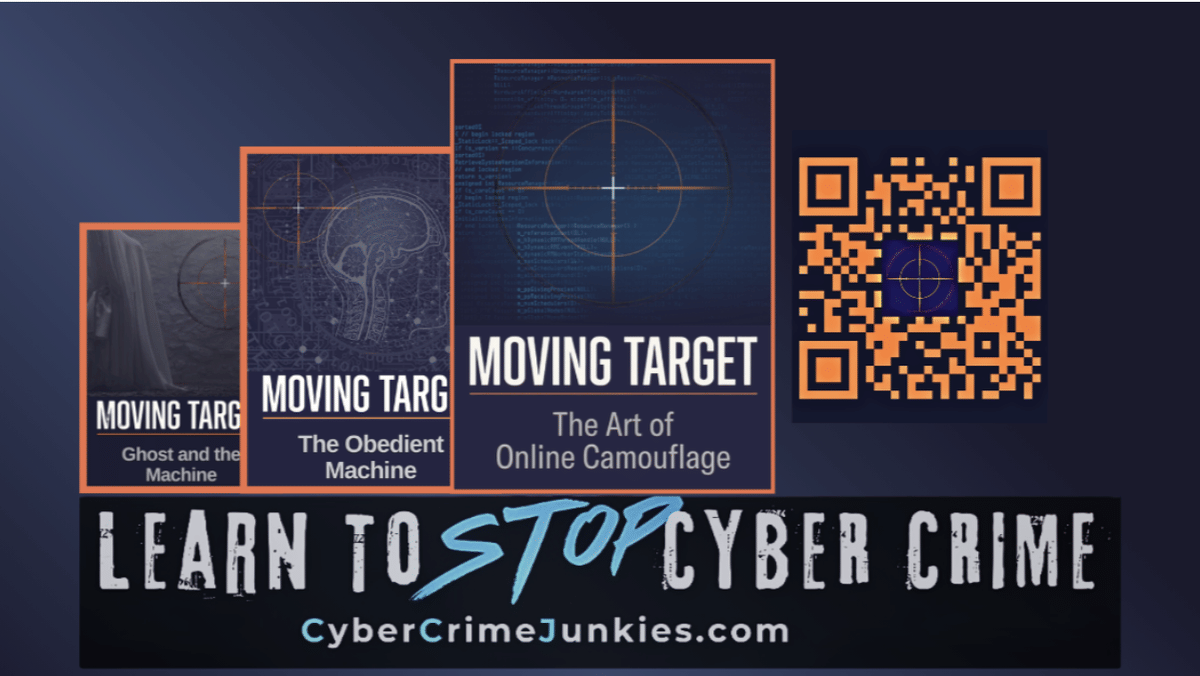
Book One: Moving Target — The Art of Online Camouflage
Available April 14 (Pre-sale out now)
Stevie Parker grew up on the northeast side of Indianapolis. Middle-class neighborhood. The kind of block where her father Sam knew every neighbor by name. The summer she was seven, their house was robbed three times. Back window. Kicked-in door. Someone who had been watching the schedule.
Sam's response was not to move. It was not to panic. It was to make the house harder than the next one. Deadbolts. A porch light on a timer. Motion sensors on both sides of the garage. He told Stevie once, in the way he explained things he wanted her to actually remember: the criminal is not picking your house because he loves your television. He is picking it because the door is unlocked. Make your door harder than your neighbor's door and the criminal keeps walking.
She grew up knowing that.
She just never applied it anywhere in her life that mattered.
That is how Book One begins.
Stevie is forty-two years old, COO of a logistics company in Indianapolis, seven percent equity partner, with a PE acquisition on the table that could change her family's life. She is capable, smart, genuinely competent. She is also reusing one password across fourteen accounts, clicking links in emails that look exactly like the ones she actually receives from vendors she trusts, logging into her bank on public WiFi because the coffee is good and the meeting is in ten minutes, and letting her elderly mother navigate a Medicare call from a voice that knew exactly which fears to press.
Each chapter follows one mistake. Alongside Stevie's story, a real criminal operation plays out — drawn from federal indictments, FBI briefings, incident response case files, and the firsthand accounts of investigators, negotiators, and survivors who have appeared on the Cyber Crime Junkies podcast. Account takeovers. Romance scams. Business email compromise. Elder fraud. Smishing operations running out of call centers with quotas and shift changes and HR departments processing performance reviews on your data.
By Chapter Eight, you understand what you are actually dealing with. Cybercrime is the third largest economy on earth. Not the third largest criminal enterprise. The third largest economy, ranked behind the United States and China. It surpassed the international drug trade years ago. The operation is not obsessed with you specifically. It is running volume. It is looking for the path of least resistance. If you are not it, it moves on.
There is always an easier target. Your job is not to build Fort Knox. Your job is to not be the easiest one on the street.
By Chapter Twelve, Stevie is not the person from Chapter One. Same person. Different behavior. That transformation is the whole point.
Book Two: Moving Target — The Obedient Machine
Available April 21 (Pre-sale out now)
The call came at 5:47am.
Three sentences. No small talk. The reps and warranties clause had been triggered. The acquisition was unwound. Hargrove Logistics Solutions was hers again.
The call ended before she could respond.
Stevie Parker sat on the edge of the bed in the dark and listened to the silence where $680,000 used to be. Not gone exactly. Just never coming. There is a specific kind of loss that works that way — the kind where nothing is taken from you because it was never officially yours to begin with. The kind where you cannot point to the moment it disappeared because there was no moment. There was just a Tuesday morning in October and a man in Chicago who had already made his decision before he dialed.
That is the opening of Book Two.
Rewind ninety days. That is where the story actually starts.
Book Two is about AI — not as a technology story, but as a crime story. It follows Stevie as her PE buyer pushes hard for AI adoption, as she evaluates vendors with no playbook and a workforce full of anxiety, as AI evolves inside her company from a glorified search engine into a strategic weapon she is only beginning to understand how to aim. It is also the story of what was already inside her systems while all of that was happening.
The breach that was seeded quietly in Book One activates here. Not because of a bad click or a weak password. Because there was no SIEM. No visibility stack. No one whose job it was to ask what was happening inside the network at two in the morning when nobody was watching. The ransomware detonated during the due diligence window. The screens went dark. The insurer engaged immediately. A ransomware negotiator was hired. The demand was in the millions. The negotiated settlement was $250,000. The decrypt key arrived and the lights came back on.
That was the good news.
The bad news was Marcus calling at 5:47am.
Alongside the breach, a synthetic identity had been hired into Stevie's team — an AI-generated persona with a perfect resume, credible references, and eleven months of access before anyone noticed anything was off. Two concurrent threats. Same root cause. No one had the visibility to see either of them coming.
What happens next is not a story about failure. It is a story about what capable people build when they have no choice but to build it fast.
In the scramble to salvage the deal, Stevie's team builds an AI-infused QC system with security architecture nobody in her logistics niche can match. The sale collapses. The company is transformed. And Stevie, sitting at a kitchen table in Indianapolis before anyone else in the house is awake, realizes something she had not expected to realize.
She never wanted to sell. She wanted to matter. The company she almost sold becomes the thing she was always meant to build.
Then her phone buzzes at 8:47am on the best morning Hargrove has logged since before October.
A voice she does not immediately recognize. A video file. Forty-three seconds. Her face. Her office. The east window with the morning light coming in at the angle it always comes in on Tuesday mornings. Her voice saying something she had never said.
The weapon that was used against her company has turned. Now it is aimed at her personally.
Book Three — Ghost and the Machine — arrives before the holidays.
Why I Wrote This
These are not IT books. I do not want you to buy a product. I need you to change your mindset.
I spent years in rooms where screens went dark and ransom demands were on every monitor and leadership teams were sitting in the half-light trying to figure out how something like this had happened to a company like theirs. It always happened the same way. Not because they were careless. Because the gap between what they assumed and what was actually happening had been open long enough for something to move through it.
This trilogy closes that gap. Not with technology. With understanding.
And understanding, it turns out, is the one thing the criminals cannot install.
Moving Target: The Art of Online Camouflage — Available April 14
Moving Target: The Obedient Machine — Available April 21
Moving Target: Ghost and the Machine — Coming Holiday 2026
*Audiobook is finalized too and will be available everywhere soon.
Find them on Amazon. Find the podcast at CyberCrimeJunkies.com. The Chaos Brief newsletter lives on LinkedIn and Substack.
Come join me.
---
By David Dean Mauro | Creator, Cyber Crime Junkies | VP of Growth, NetGain Technologies | FBI InfraGard Member