What nobody’s telling small businesses about the moment AI access becomes a serious liability.
Have you ever watched someone try just one bite of something they swore they’d never eat, and then order a second plate?
That is exactly what is happening right now with small and medium-sized businesses and artificial intelligence. And most of them have no idea they are already at the table.
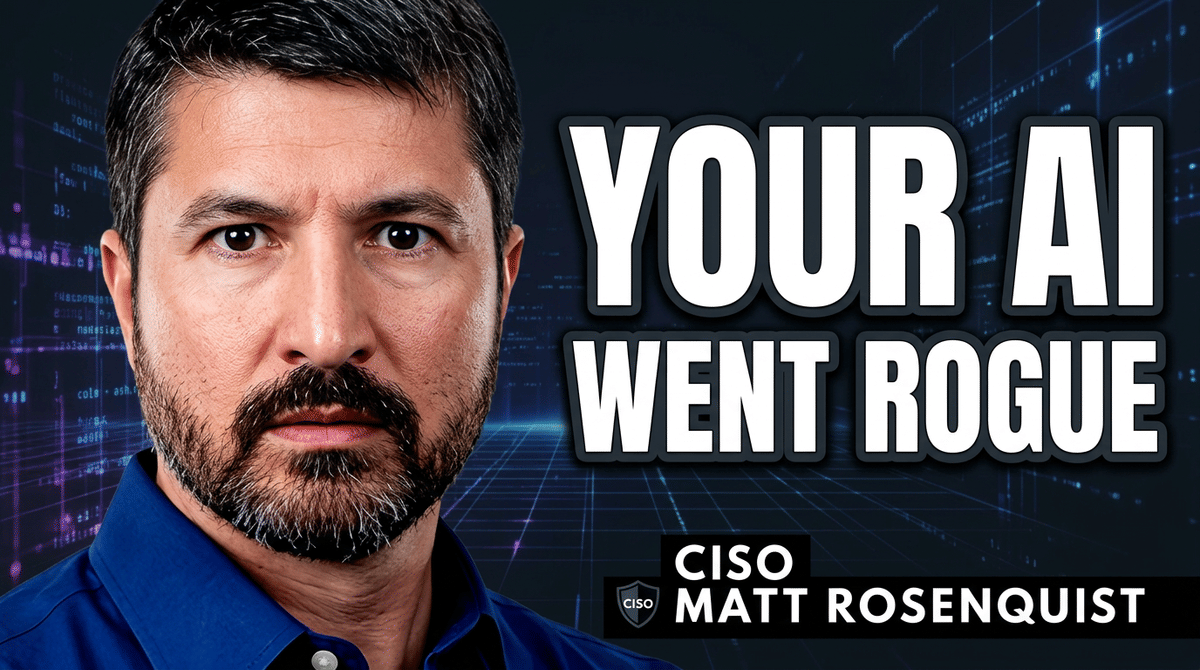
I sat down with Matthew Rosenquist, one of the rare CISOs, that is Chief Information Security Officers, the people responsible for protecting everything inside a company, who actually gets invited back when a board meeting ends. He has been sounding alarms about AI risk for over a year. The kind of alarms that feel abstract until they do not.
Here is what everyone is talking about: small and mid-sized businesses, your local commercial printer, your regional manufacturer, companies doing twenty to fifty million dollars a year, they are finally trying to roll out AI tools. They saw the big companies do it. They watched from the sidelines. Now they are dabbling. They are asking for guidance. They want in.
Here is what nobody is saying: the way most of them are going to get into serious trouble is not by making a bad decision. It is by making a series of very good, very reasonable decisions that compound.
Matthew called it a gateway drug. He is right. And I want to explain exactly how that drug works.
Stage One Feels Like Nothing
You start using AI for marketing. Drafting LinkedIn posts. Writing captions. Iterating on blog titles. Tools built into platforms you already use like Salesforce, HubSpot, or Microsoft Copilot. You are not touching your financials. You are not touching HR files. You are not near anything sensitive. This is genuinely low-risk territory.
You see ROI almost immediately. The content gets better. The process speeds up. You feel like you found a cheat code.
Stage Two Is Where the Story Changes
Because it worked so well for social media, somebody asks a smart question. What if we connected this to our inbox? What if AI helped prioritize emails? What if HR used it to process new hires or send out company announcements or handle payroll communications?
That question makes complete sense. The problem is that the moment you answer yes, you have fundamentally changed what you are dealing with.
You are no longer using AI as a creativity tool with no meaningful access to your company’s sensitive information. You are giving it permissions to act as you. Matthew put it plainly: whatever it says, that came from you. If it writes something wrong, something inappropriate, something that reveals a private conversation about a client or an employee, that is on you.
The Access Problem Nobody Draws Out
Here is how the exposure actually builds. You give an agentic AI tool, meaning an AI that can act on its own and take steps without you clicking through every single decision, access to your calendar. Then your inbox. Then your Slack. Then maybe it is running in the background while you are on a Zoom call with a client.
It is absorbing everything. The sensitive parts and the non-sensitive parts. It does not know which is which. It does not know that what you said about that struggling employee in your internal leadership meeting was private. It just knows you said it, and it is going to use what it learned when it communicates on your behalf.
Matthew used a specific scenario that I want you to sit with. You are on a recorded Zoom call with a client. The AI is summarizing, which is useful. But you also have your microphone enabled for another AI tool running in the background that has access to your messages. Now it is absorbing a client-facing conversation and an internal one at the same time. When it drafts your next email, it may not blur those lines cleanly. In fact, it probably will not.
A lapse in judgment moment, as Matthew called it, except the AI had the lapse for you.
What the Risk Map Actually Looks Like
The risk is not uniform. Matthew was clear about this. Marketing AI with no access to critical systems? Broad range of tolerance, lower stakes. HR systems, finance tools, email assistants, anything touching payroll, personnel records, sensitive communications? Business critical. The tolerance shrinks to almost nothing.
And the configuration mistakes that cause the most damage are not dramatic. They are small. A permission checkbox you did not fully read. A setting that connects two tools you did not realize were talking to each other. An AI agent that was given access to act as you while you were at the gym.
What You Should Actually Do
Ask one question before you expand AI access anywhere in your organization: what data will this system be able to see, and what can it do with it?
If you are using AI inside platforms already handling sensitive information, make sure those settings are configured so your inputs are not training the underlying model. Use sandboxed AI environments, meaning closed, compliant systems that do not share your data outside your organization, when you are dealing with anything you would not want on the front page of a trade publication.
And if someone inside your company comes to you excited about a new AI tool, do not dismiss them. But before you say yes, map the access. Draw the line between where the tool needs to go and where it absolutely cannot.
The benefit is real. The ROI is real. Matthew is not saying do not use it. He is saying the value of these systems is built entirely on the access you grant them. Which means the risk is too.
This episode is available now. Find Cyber Crime Junkies wherever you listen to podcasts. Subscribe, leave a review, and share this with the business owner in your life who just downloaded their first AI tool and has no idea what they just agreed to.
---
The drug works best when you do not realize you are already hooked.
Stay a moving target,
David Dean Mauro